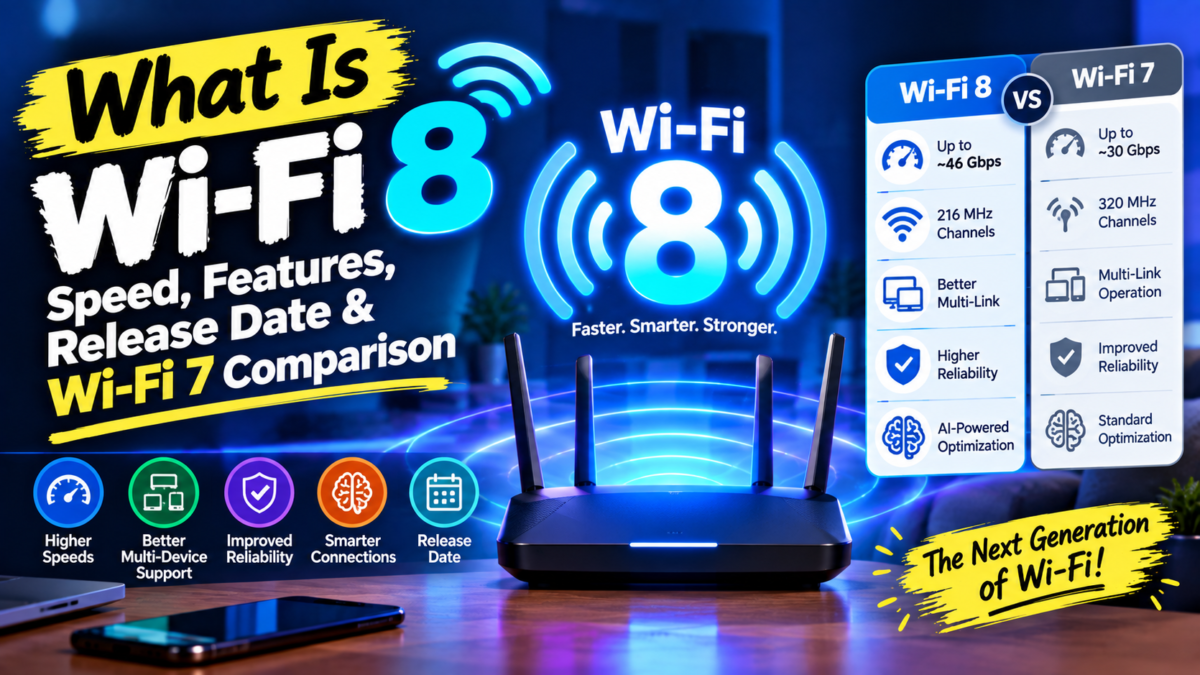
What Is Wi-Fi 8? Speed, Features, Release Date & Wi-Fi 7 Comparison
Wi-Fi 8 is the next generation of wireless networking technology after Wi-Fi 7. It is being developed under the IEEE 802.11bn standard and is known technically as Ultra High Reliability (UHR).
But Wi-Fi 8 is different from many previous Wi-Fi upgrades.
Instead of focusing mainly on making the maximum advertised speed dramatically higher, Wi-Fi 8 is being designed to make wireless connections more reliable, responsive and consistent in real-world conditions.
That means better performance when you are far from the router, when many devices are connected, when neighboring networks cause interference, or when a device moves between access points.
Wi-Fi 8 hardware is already beginning to appear in 2026, but the underlying standard is still being finalized.
What Is Wi-Fi 8?
Wi-Fi 8 is the consumer name associated with the upcoming IEEE 802.11bn wireless standard.
Its development focuses on what the IEEE calls Ultra High Reliability.
The goal is not simply to achieve a bigger number on a router box. Wi-Fi 8 is designed to improve how consistently a wireless network performs under difficult conditions.
The IEEE’s current objectives include modes capable of delivering at least a 25% throughput improvement at certain signal-to-interference levels, a 25% reduction in 95th-percentile latency, and a 25% reduction in packet loss compared with Wi-Fi 7’s Extremely High Throughput operation in defined scenarios.
In simple terms, Wi-Fi 8 is trying to make Wi-Fi work better when the network is under stress.
Wi-Fi 8 at a Glance
| Feature | Wi-Fi 8 |
|---|---|
| IEEE standard | 802.11bn |
| Technical focus | Ultra High Reliability |
| Frequency operation | 2.4 GHz, 5 GHz and 6 GHz legacy-compatible operation |
| Maximum channel width in current platforms | Up to 320 MHz |
| Main improvement | Reliability, latency, coverage and consistency |
| Previous generation | Wi-Fi 7 / 802.11be |
| First early consumer products | Beginning to appear in 2026 |
| Final IEEE approval | Expected in 2028 |
| Wi-Fi Alliance certification | Projected around January 2028 |
The important point is that early 2026 hardware is based on the developing/draft specification, rather than a final Wi-Fi 8 standard. Qualcomm says final IEEE approval is expected in 2028, with certified products expected around the start of Wi-Fi Alliance certification.
How Fast Is Wi-Fi 8?
This is where Wi-Fi 8 can initially seem confusing.
People are accustomed to a new Wi-Fi generation meaning:
higher maximum speed = better Wi-Fi.
Wi-Fi 8 changes that emphasis.
Current Wi-Fi 8 platforms can still support extremely high throughput. Qualcomm’s F8 platform, for example, lists a peak PHY rate of up to 23 Gbps, tri-band operation and channel widths up to 320 MHz. However, those are platform specifications and should not be interpreted as the speed an ordinary device will receive over the internet.
The more important improvements are expected to appear when conditions are less than perfect.
For example:
- farther away from the router
- through walls
- around competing Wi-Fi networks
- with many connected devices
- while moving between access points
- in environments with substantial interference
So the better question may eventually be:
“How consistently fast is Wi-Fi 8?”
rather than simply:
“What is Wi-Fi 8’s maximum speed?”
What Is Ultra High Reliability?
Ultra High Reliability, or UHR, is central to Wi-Fi 8.
Imagine that your internet connection is capable of 1 Gbps.
Sitting beside the router, your Wi-Fi may perform very well.
Move to another room, add dozens of connected devices, introduce neighboring networks and start moving between access points, and the experience can become less consistent.
Wi-Fi 8 is being developed to improve performance under these more difficult conditions.
Qualcomm describes UHR as an effort to provide consistently low-latency and high-throughput connectivity in challenging situations such as dense networks, coverage edges and device mobility.
What Are the Main Features of Wi-Fi 8?
Wi-Fi 8 includes a number of technical improvements. You do not need to understand every acronym to understand what they are trying to accomplish.
1. Better Performance at Longer Range
One Wi-Fi 8 technology is Enhanced Long Range (ELR).
Its purpose is to improve connectivity for devices operating farther from an access point or under difficult signal conditions.
This doesn’t mean Wi-Fi 8 suddenly provides unlimited range.
Instead, the goal is to make connections toward the edge of usable Wi-Fi coverage more dependable.
2. Distributed Resource Units
Distributed Resource Units (DRU) are another important development.
Modern Wi-Fi can divide available spectrum among devices. Wi-Fi 8 improves how these resources can be distributed, particularly helping uplink performance for devices with weaker transmission capabilities.
Qualcomm explains that DRU can spread tones over a wider frequency range, helping improve signal robustness while operating within applicable power limits.
For an ordinary user, the intended result is better reliability for distant or lower-powered devices.
3. Non-Primary Channel Access
Wi-Fi networks can experience problems when part of the available spectrum becomes busy.
Non-Primary Channel Access (NPCA) is designed to use available spectrum more efficiently rather than allowing congestion on one portion of a channel to unnecessarily limit the entire connection.
This should be particularly useful in environments with many competing devices and networks.
TP-Link specifically highlights NPCA as one of the technologies it expects to help its upcoming Wi-Fi 8 hardware remain responsive when more devices are connected.
4. Unequal Modulation
Another Wi-Fi 8 technology is Unequal Modulation, or UEQM.
Multiple spatial streams do not always experience identical signal conditions.
Wi-Fi 8 can adapt modulation more intelligently across those streams rather than treating all of them identically.
The goal is more consistent performance when interference or signal quality is uneven.
5. Lower Latency
Speed is not the only thing that determines whether a network feels fast.
Latency is the delay involved in transmitting data.
Lower and, importantly, more predictable latency matters for applications such as:
- online gaming
- video calls
- cloud applications
- mixed reality
- remote computing
- real-time AI applications
The IEEE’s Wi-Fi 8 project explicitly includes reducing high-percentile latency compared with Wi-Fi 7 as one of its UHR performance goals.
6. Reduced Packet Loss
Data transmitted wirelessly is divided into packets.
If packets are lost, they may need to be retransmitted, which can hurt responsiveness and reliability.
Reducing packet loss is another explicit goal of 802.11bn, particularly in challenging scenarios such as transitions between wireless access points.
7. Better Roaming
Wi-Fi 8 is also being developed with mobility in mind.
This matters in larger homes, offices, campuses and other environments where a device may move between multiple access points.
Ideally, users should be able to move without noticing significant interruptions as their device changes its wireless connection.
Wi-Fi 8 vs Wi-Fi 7: What’s the Difference?
Wi-Fi 7 was a major performance upgrade and introduced technologies designed for extremely high throughput.
Wi-Fi 8 builds on that foundation but shifts more attention toward reliability and consistency.
| Feature | Wi-Fi 7 | Wi-Fi 8 |
|---|---|---|
| IEEE standard | 802.11be | 802.11bn |
| Main theme | Extremely High Throughput | Ultra High Reliability |
| 320 MHz channels | Yes | Yes in current implementations |
| 2.4/5/6 GHz operation | Yes | Yes |
| Reliability improvements | Advanced | Major focus |
| Edge-of-coverage performance | Improved | Further targeted improvements |
| Congestion handling | Advanced | Further improvements |
| Latency | Very low possible | More emphasis on consistent low latency |
| Status | Commercially available | Standard still under development |
The key difference can therefore be summarized simply:
Wi-Fi 7 focuses heavily on extremely high performance. Wi-Fi 8 focuses on making high performance more dependable.
That does not mean Wi-Fi 8 will be slow. It means raw peak speed is not the only target.
Is Wi-Fi 8 Faster Than Wi-Fi 7?
Potentially, depending on the situation—but this question needs context.
Wi-Fi 8 is not simply being designed around doubling Wi-Fi 7’s headline maximum speed.
Instead, improvements target effective throughput under real-world conditions.
A Wi-Fi 8 connection may therefore provide its most noticeable advantage when:
- signal quality is weaker
- the network is congested
- interference is present
- many devices are connected
- you are moving around a building
In an ideal environment close to a router, the difference may be less dramatic than the generation number suggests.
When Will Wi-Fi 8 Be Released?
The answer depends on what you mean by “released.”
Early Wi-Fi 8 hardware is already beginning to emerge in 2026, even though the IEEE standard itself is not final.
For example, TP-Link announced its first Wi-Fi 8 lineup at IFA 2026, including the Archer 8 Ultra router and Deco 8 Ultra mesh system.
However, Qualcomm says final IEEE approval of 802.11bn is expected in 2028, while Wi-Fi Alliance certification is currently projected for around January 2028.
So there are really two timelines:
Early/draft-based hardware: 2026 onward
Finalized/certified Wi-Fi 8 ecosystem: expected around 2028
What Are the First Wi-Fi 8 Routers?
One of the first major consumer Wi-Fi 8 announcements comes from TP-Link.
The company unveiled a lineup led by:
TP-Link Archer 8 Ultra
TP-Link describes the Archer 8 Ultra as a tri-band Wi-Fi 8 router with up to 19 Gbps aggregate advertised wireless capacity, 10 Gbps wired connectivity and 18 internal antennas.
Regional preorders are scheduled to begin on September 30, 2026.
TP-Link Deco 8 Ultra
The Deco 8 Ultra is a Wi-Fi 8 mesh system.
TP-Link says it can provide up to 22 Gbps aggregate advertised wireless capacity in the announced configuration, with a three-unit setup designed for large whole-home coverage and more than 200 connected devices.
Availability and specifications can vary by region, and TP-Link says additional details will be provided during its September 30 launch event.
These products are important examples of the industry moving toward Wi-Fi 8, but they are based on an upcoming standard, not a finalized IEEE specification.
Should You Buy a Wi-Fi 8 Router in 2026?
For most people, there is no need to rush.
Wi-Fi 7 is already extremely capable, and Wi-Fi 8 is still going through standardization.
Buying very early Wi-Fi 8 hardware may make sense for technology enthusiasts, network professionals or people who specifically want to experiment with next-generation networking.
For an ordinary home user, waiting has several advantages:
- more Wi-Fi 8 devices will become available
- prices should become clearer
- laptops and phones will gain broader support
- firmware will mature
- the standard will move closer to finalization
- certification will eventually provide more certainty around interoperability
If your current Wi-Fi 6, Wi-Fi 6E or Wi-Fi 7 network already works well, there is little reason to replace it simply because Wi-Fi 8 products have started appearing.
Will Old Devices Work With Wi-Fi 8?
Yes, backward compatibility is part of the 802.11bn project.
The IEEE says Wi-Fi 8 is intended to coexist with legacy 802.11 devices across the familiar unlicensed 2.4 GHz, 5 GHz and 6 GHz bands.
So buying a Wi-Fi 8 router should not mean throwing away all your older Wi-Fi devices.
However, an older device will not suddenly gain Wi-Fi 8-specific capabilities.
To benefit fully from the new standard, both the network infrastructure and client device will need appropriate support.
Will Wi-Fi 8 Improve Internet Speed?
Not automatically.
Your Wi-Fi connection and your internet connection are related but different.
If your internet provider gives you a 100 Mbps connection, buying a router capable of multi-gigabit wireless speeds does not turn that internet plan into 10 Gbps.
Wi-Fi 8 can improve the wireless connection between your devices and network, but your internet speed is still limited by factors such as:
- ISP plan
- modem or fiber equipment
- wired network ports
- server speed
- network congestion
The biggest Wi-Fi 8 benefits may therefore be improved local networking and more consistent wireless performance rather than a higher result on every internet speed test.
Who Will Benefit Most From Wi-Fi 8?
Wi-Fi 8 could be particularly useful in environments where reliable connectivity is more important than achieving a record benchmark.
Examples include:
Smart Homes
Homes may contain dozens of phones, TVs, cameras, speakers, appliances and smart-home devices.
Improved congestion management and reliability can become increasingly important as that number grows.
Gaming
More consistent latency and fewer dropped packets could improve online gaming, especially in busy wireless environments.
AR and VR
Immersive applications require both high throughput and low latency.
Connection interruptions can be much more noticeable in these environments.
Offices
Large offices with many users and access points could benefit from improved mobility, coordination and reliability.
AI-Connected Devices
As more AI processing moves between local devices and cloud services, dependable low-latency networking may become increasingly important.
Qualcomm specifically positions Wi-Fi 8 around increasingly demanding environments including intelligent systems, connected device ecosystems and mission-critical applications.
Is Wi-Fi 8 Worth Waiting For?
If you already own a good Wi-Fi 7 router, probably not solely for the sake of upgrading.
Wi-Fi 7 remains a modern, high-performance standard.
If you have an older router and need an upgrade immediately, waiting until 2028 simply to buy Wi-Fi 8 may also be unnecessary.
Wi-Fi 8 becomes more interesting if you:
- plan to keep your next router for many years
- have many connected devices
- experience serious congestion
- need highly reliable wireless connectivity
- operate a large mesh network
- want early access to next-generation networking
For most consumers, the best time to seriously evaluate Wi-Fi 8 will be when certified hardware and compatible phones, laptops and other client devices become widely available.
Final Verdict
Wi-Fi 8 represents an important change in how the wireless industry thinks about progress.
Previous generations often attracted attention through increasingly large maximum-speed figures. Wi-Fi 8 is putting more emphasis on what users actually experience: Does the connection remain fast and responsive when conditions become difficult?
Its IEEE 802.11bn standard is being developed around Ultra High Reliability, targeting improvements in latency, packet loss, throughput under challenging signal conditions, coverage and mobility.
Early Wi-Fi 8 hardware is arriving in 2026, but consumers should remember that the standard is not finished yet. Final IEEE approval and Wi-Fi Alliance certification are expected around 2028.
For now, Wi-Fi 7 remains more than sufficient for most users. But Wi-Fi 8 gives us a clear picture of where wireless networking is heading: not just toward faster Wi-Fi, but toward Wi-Fi that works more consistently wherever and whenever you need it.