What’s the Difference Between Claude and ChatGPT?
Claude and ChatGPT are two of the most popular AI assistants available today. Both can answer questions, explain difficult topics, help with writing, analyze documents, assist with coding, and search the web.
However, they are not exactly the same.
ChatGPT is developed by OpenAI, while Claude is developed by Anthropic. Their interfaces, tools, subscription plans, and workflows differ, so the better choice depends on what you want an AI assistant to do.
Quick Answer
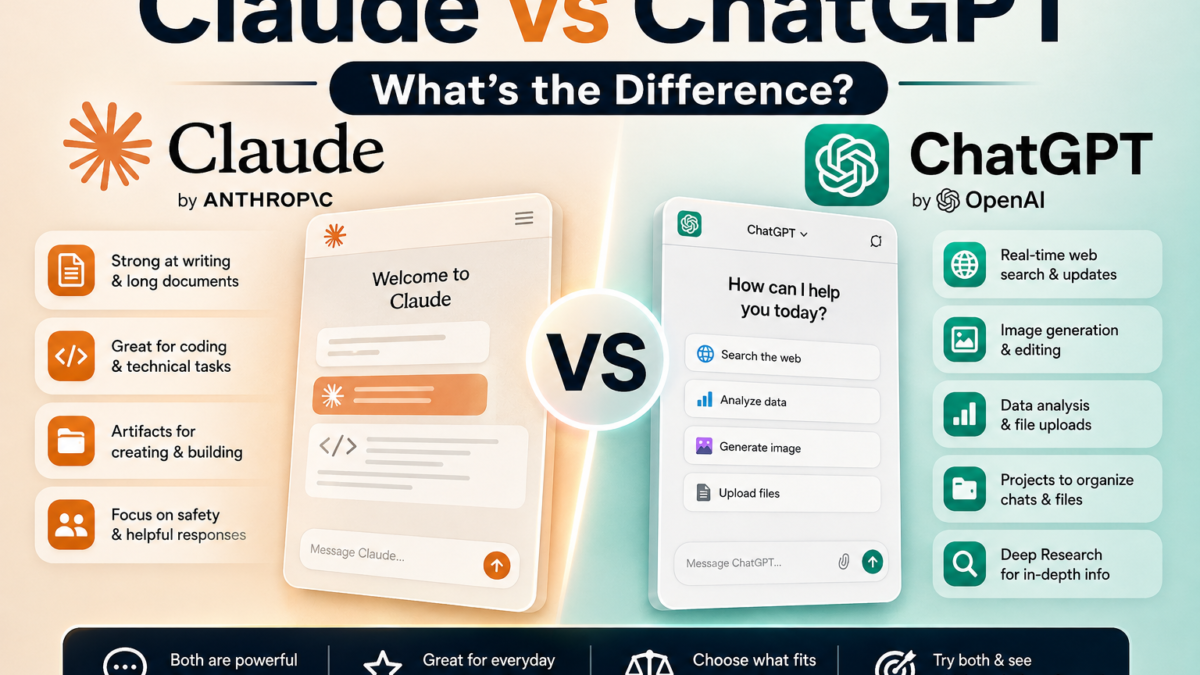
Claude and ChatGPT are both powerful general-purpose AI assistants. ChatGPT offers a particularly broad set of integrated capabilities, including web search, image generation, file analysis, data analysis, Projects, and Deep Research. Claude is especially useful for document-heavy work, writing, coding, long-context tasks, Artifacts, and its expanding productivity tools. Both have free plans, while ChatGPT Plus and Claude Pro are each currently $20 per month in the US.
Claude vs ChatGPT at a Glance
| Feature | ChatGPT | Claude |
|---|---|---|
| Developer | OpenAI | Anthropic |
| Free plan | Yes | Yes |
| Main individual paid plan | Plus | Pro |
| Monthly price | $20/month | $20/month in US |
| Web search | Yes | Yes |
| File/PDF analysis | Yes | Yes |
| Image understanding | Yes | Yes |
| Image generation | Yes | Not a primary native image-generation feature |
| Coding assistance | Yes | Yes |
| Research tools | Deep Research | Research |
| Workspace feature | Projects | Projects |
| Specialized workspace | — | Artifacts |
| Higher individual tiers | Pro | Max |
Pricing and available features can change over time and may vary by region or plan.
What Is ChatGPT?
ChatGPT is an AI assistant developed by OpenAI. You can use it for everyday questions, writing, brainstorming, learning, programming, research, document analysis, images, and many other tasks.
Depending on the plan and available tools, ChatGPT can search the web, analyze uploaded documents, work with images, perform data analysis, generate images, conduct deeper research, and organize ongoing work inside Projects.
For example, you could upload a spreadsheet and ask ChatGPT to analyze the data, upload a PDF and ask questions about it, or ask it to research a subject using online sources.
What Is Claude?
Claude is an AI assistant developed by Anthropic. Like ChatGPT, it can help with writing, explanations, research, coding, document analysis, and many everyday productivity tasks.
Claude supports uploads including PDF, DOCX, CSV, TXT, HTML, images and several other formats. It can therefore be useful when you want to discuss or analyze information contained in documents.
Claude also offers Artifacts, which provide a dedicated space for creating and working with substantial content, applications, visualizations, tools, and other interactive outputs.
1. Writing and Content Creation
Both Claude and ChatGPT can help you:
- Write articles and blog posts
- Rewrite existing text
- Generate ideas
- Create outlines
- Improve grammar
- Summarize information
- Draft emails and social-media content
The difference often comes down to the type of workflow and writing style you prefer.
Claude can be particularly convenient when you are working extensively with documents or building substantial content through Artifacts.
ChatGPT combines writing with a wider collection of integrated tools, making it convenient when a project moves between writing, research, images, files, and data.
For ordinary writing, however, both are very capable.
2. PDF and Document Analysis
Both Claude and ChatGPT can work with uploaded documents.
ChatGPT supports document uploads for tasks such as summarizing papers, comparing documents, extracting specific information, analyzing spreadsheets, and answering questions based on uploaded files.
Claude also supports numerous document formats, including PDF, DOCX, CSV, TXT, HTML, EPUB, JSON and XLSX under applicable settings.
So there isn’t a simple winner here.
If your work revolves heavily around long documents, you may prefer Claude’s workflow. If you need to combine documents with research, data analysis, images, or other ChatGPT tools, ChatGPT may be more convenient.
3. Web Search and Research
Both services can access current information from the web.
ChatGPT supports web search and can provide cited answers. Its Deep Research feature is designed for more complicated research tasks involving multiple sources, uploaded files, and connected data sources.
Claude also provides web search with citations and offers research capabilities on supported plans.
For simple searches, both can be useful. For serious research, you should still check the cited sources instead of assuming that every AI-generated statement is correct.
4. Image Capabilities
This is one of the clearer differences.
ChatGPT can both analyze images and generate images. You can upload screenshots, diagrams, photographs, or charts and ask questions about them. You can also ask ChatGPT to create or modify images.
Claude supports image uploads and visual understanding, but its core Claude chat product is not positioned around native image generation in the same way.
Therefore, if AI image generation is important to you, ChatGPT has the advantage.
5. Coding
Both ChatGPT and Claude can help programmers write, explain, debug, and improve code.
Claude’s paid Pro plan includes Claude Code, while its Artifacts system can also be useful for creating and iterating on interactive tools and applications.
ChatGPT can similarly assist with programming, analyze uploaded files, perform data analysis, and work through complex technical problems.
Which is better for coding can vary substantially by programming language, project, model, and task, so it is better to test both on your actual workload rather than assume one will always produce better code.
6. Projects and Ongoing Work
Both platforms now provide ways to organize longer-running work.
ChatGPT Projects can keep chats, files, instructions, and relevant context together. They are useful for ongoing activities such as research, writing, planning, and repeated workflows.
Claude also includes Projects, with its current Pro offering providing unlimited projects for organizing chats and documents.
This makes both platforms considerably more useful for ongoing projects than treating every AI conversation as an isolated chat.
7. Claude Artifacts vs ChatGPT’s Broader Toolset
Claude’s Artifacts are one of its distinctive features.
An Artifact gives substantial standalone content its own workspace alongside the conversation. Anthropic describes Artifacts as a way to build content, apps, tools, visualizations, and interactive experiences.
ChatGPT takes a somewhat different approach by integrating a broad collection of capabilities into the overall product, including web search, file analysis, data analysis, image generation, Projects, Deep Research, voice and other tools.
Neither approach is automatically better. They simply support somewhat different workflows.
8. Claude vs ChatGPT Pricing
Both services offer free access.
For individual users, ChatGPT Plus costs $20 per month. OpenAI says Plus provides higher limits and broader access to models and features than the Free plan.
Claude Pro also costs $20 per month in the US, while Anthropic currently offers a discounted annual option. Claude also has Max tiers for users who need substantially more usage.
Both companies offer additional plans beyond these standard subscriptions, so the exact plan you need depends on your usage.
Which Is Better: Claude or ChatGPT?
There is no universal winner.
Choose ChatGPT if you want a broad all-in-one AI assistant that combines conversation with image generation, web search, research, document analysis, data analysis and other integrated tools.
Choose Claude if you want a strong writing, coding and document-focused assistant and particularly like Claude’s Artifacts, Claude Code, long-context workflows, or Anthropic’s productivity ecosystem.
For many people, the decision will simply come down to which interface, responses, and tools better match their everyday work.
Can You Use Both?
Yes.
You don’t necessarily need to choose only one AI assistant.
For example, you could use Claude for document-heavy writing or coding work and ChatGPT for research, image generation, data analysis, or other multimodal tasks.
Because both offer free access, you can also test the same real-world task in each platform before deciding whether either paid subscription is worthwhile.
Final Verdict
Claude and ChatGPT have increasingly overlapping capabilities, but they still have different strengths.
ChatGPT stands out for its broad integrated toolset and multimodal capabilities. Claude stands out for its document, coding, long-context and Artifact-centered workflows.
For most users, the best AI assistant is the one that performs better on the specific work they actually do rather than the one that wins a general feature comparison.
Want to try Claude yourself? See whether Claude is free and how to get started with Claude. You can also check whether ChatGPT is free for the full picture.
If you run into common ChatGPT problems while comparing the two assistants, our guide covers the most common ChatGPT problems and how to resolve them.